
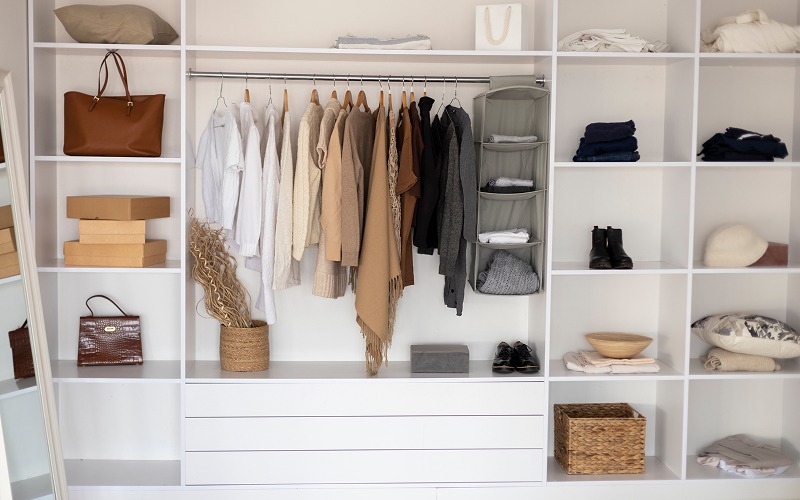
Image Recommendation: A neatly organised wardrobe interior showing a mix of hanging space, folded shelves, and drawers, bright and tidy HDB bedroom setting.
Measuring for a wardrobe usually means measuring the wall: how wide the space is, how tall the ceiling allows, whether a door will clear the swing. Those numbers matter, but they only describe the box. What actually determines whether a wardrobe works day to day is what’s planned to go inside it, and that step gets skipped far more often than the wall measurement does.
What a Wardrobe in Singapore Needs to Hold
Before choosing a wardrobe in Singapore, it helps to separate clothing into three rough categories: items that need full-length hanging space, like dresses and coats; items that work fine folded on a shelf, like t-shirts and sweaters; and smaller items better suited to drawers, like underwear and accessories. Most wardrobes are built around a fixed ratio of these three, and the mismatch between that fixed ratio and an actual household’s clothing mix is where storage problems usually start.
A household with mostly folded clothing and very little that needs long hanging space will find a wardrobe weighted toward hanging rails frustrating, with wasted vertical space below every garment. The reverse is just as common: plenty of shelves, but never quite enough hanging rail for the coats and dresses that actually need it.
Any wardrobe in Singapore shopped for without this count done first is really a guess dressed up as a measurement, however precise the wall numbers are.
The Three Storage Types Worth Counting Before Buying
- Long-hanging items: dresses, coats, formal wear that can’t be folded
- Foldable items: t-shirts, sweaters, loungewear suited to shelves or stacks
- Small items: accessories, underwear, and anything better suited to drawers
A rough count of how much of each category a household actually owns, rather than a guess, makes it far easier to pick a configuration that fits real usage instead of a generic default.
Matching a Configuration to the Count, Not the Other Way Around
| Household Mix | Configuration That Tends to Fit |
| Mostly folded clothing, few long items | Shelf-heavy cabinet with a small hanging section |
| Lots of dresses, coats, or formal wear | A wardrobe with a full-height hanging rail as the main feature |
| Shared use by two people | A wider unit with a clear hanging-and-shelf split per person |
Why Affordable Doesn’t Have to Mean Fixed and Generic
There’s a common assumption that getting the configuration right requires a custom carpentry job well outside a typical budget. In practice, affordable furniture in Singapore now comes in enough shelf, drawer, and hanging-rail combinations that most households can find something close to their actual mix without paying for a fully bespoke build. The key is checking the specific configuration listed for a unit, not just its overall size, before assuming any wardrobe in the right footprint will work equally well.
That extra five minutes spent comparing interior layouts against an honest count of what actually needs storing tends to matter far more, over years of daily use, than the exact wood finish or handle style chosen.
Budget range doesn’t need to dictate configuration choice either. Shopping for affordable furniture in Singapore doesn’t mean settling for whichever ratio happens to be cheapest to produce, since entry-level and higher-priced units alike tend to come in a range of shelf-to-hanging ratios. The right interior layout is usually available somewhere within most budgets, not locked to whichever price tier happens to be most expensive.
It’s worth checking the product listing’s interior breakdown specifically, rather than judging a unit purely by its outer dimensions or price, since two wardrobes of identical size and similar cost can have noticeably different internal splits between hanging rail and shelving.
A quick side-by-side comparison of two or three listings, interior layout against interior layout rather than price against price, usually makes the right choice obvious within a few minutes. That comparison is exactly what makes affordable furniture in Singapore worth shopping carefully rather than grabbing the first unit that fits the wall.
Measuring the Room Is Only Step One
None of this replaces measuring the wall. A wardrobe still has to physically fit the space, clear the door swing, and leave room to move around it. But treating the wall measurement as the only measurement that matters is how a household ends up with a wardrobe that fits the room perfectly and the clothes inside it poorly.
The two measurements, the wall and the wardrobe’s own interior layout, work together rather than competing for attention. Getting one right and ignoring the other tends to produce exactly the same disappointment either way, just for different reasons.
A household moving into a new flat, or simply replacing an old wardrobe in Singapore, has a natural opportunity to do both properly at once, rather than carrying forward whatever configuration happened to come with the last unit by default.
Getting both measurements right, the wall and the wardrobe, makes the difference between storage that works and storage that’s merely the right size. Contact TheFurniture to find a configuration that matches what’s actually going inside it.

More Stories
How to Fix Backlink Indexing Issues for Real Estate and Home Businesses
Practical Shelf Lighting Layouts for Kitchens, Libraries and Display Furniture
Why Ipe Hardwood Siding Is a Smart Choice for Premium Exterior Design